
Taking Anzupgo®1
What you should know before taking Anzupgo®

Do not use Anzupgo®
- If you are allergic to delgocitinib, benzyl alcohol (E 1519), butylhydroxyanisole (E 320), cetostearyl alcohol, citric acid monohydrate (E 330), disodium edetate, hydrochloric acid (E 507), liquid paraffin, macrogol cetostearyl ether, and/or purified water.
Warnings and precautions
- Talk to your doctor, pharmacist or nurse before using Anzupgo®
- Do not smoke or go near naked flames – risk of severe burns. Fabric (clothing, bedding, dressings etc.) that has been in contact with this product burns more easily and is a serious fire hazard. Washing clothing and bedding may reduce product build-up but not totally remove it.

Children and adolescents
Do not use this medicine in children and adolescents below the age of 18 years because it has not been studied in this age group.
If you are taking care of a baby, you should also take care to avoid hand contact with the baby’s skin immediately after applying Anzupgo®. This is a precaution to limit any unnecessary exposure of the baby to this medicine. In the event of accidental transfer of the cream to the baby’s skin, the cream can be wiped off.

Pregnancy, breast-feeding and fertility
If you are pregnant or breast-feeding, think you may be pregnant or are planning to have a baby, ask your doctor for advice before using this medicine.
The effects of this medicine in pregnant women are not known; therefore, it is preferable to avoid the use of Anzupgo® if you are pregnant or think you may be pregnant.
It is unknown whether delgocitinib passes into human breast milk, but only very small amounts of this medicine are absorbed into the body. No risk to the baby is therefore anticipated and Anzupgo® can be used during breast-feeding.
However, if you are breast-feeding, you should take care that this medicine does not to come into contact with your nipple or any other area where your baby may ingest it during feeding.

Driving and using machines
This medicine is not expected to have any effect on your ability to drive or to use machines.

How to store Anzupgo®
Keep this medicine out of the sight and reach of children.
Do not use this medicine after the expiry date which is stated on the tube and carton after ‘EXP’. The expiry date refers to the last day of that month.
Do not freeze.
The tube should be discarded 1 year after first opening.
Do not throw away any medicines via wastewater or household waste. Ask your pharmacist how to throw away medicines you no longer use. These measures will help protect the environment.

Anzupgo® contains benzyl alcohol, butylhydroxyanisole, and cetostearyl alcohol
This medicine contains 10 mg of benzyl alcohol (E 1519) in each gram. Benzyl alcohol may cause allergic reactions or mild local irritation.
Butylhydroxyanisole (E 320) may cause local skin reactions (e.g. contact dermatitis) or irritation to the eyes and mucous membranes.
Cetostearyl alcohol may cause local skin reactions (e.g. contact dermatitis).
How to use Anzupgo®:1
- . Screw off the cap.
- . Peel off the seal at the top end of the tube. Screw the cap back on.
- . Apply a thin layer of Anzupgo® twice a day to the affected areas of your hands and wrists. Make sure your skin is clean and dry.
Avoid applying other products, such as creams or ointments, to the skin immediately before or after application of Anzupgo®.
If someone else applies this medicine to your skin, they should wash their hands after application.
Please consult the PIL found within your medicine pack for full details on how to apply Anzupgo®.
How long to use Anzupgo® for1
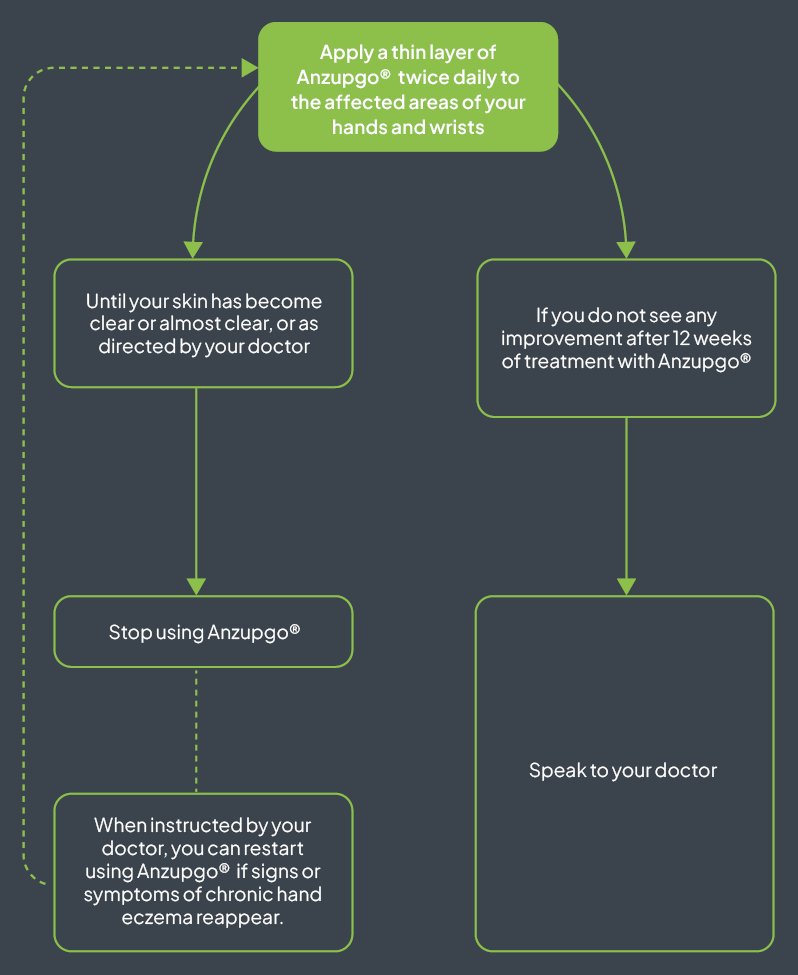
As instructed by your doctor, you can restart twice-daily treatment with Anzupgo® if signs or symptoms of Chronic Hand Eczema (CHE) reappear. Use this diagram to determine when to stop or restart treatment.1
References
UK MAT-8263 April 2025
- UK Anzupgo® PIL